
The Flesh-and-Bone Turing Test: The Singularity of Medical Automation
Experience
Salamon & Salamon
5/7/20262 min read
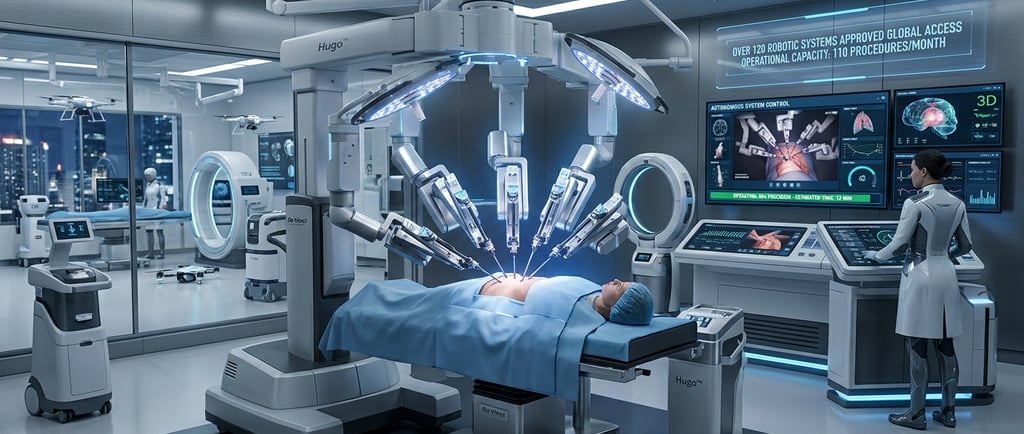
In 1950, Alan Turing challenged us to distinguish between human and artificial thought. Today, in the world’s most advanced surgical theaters, the challenge has shifted: it is no longer a question of whether a machine can think like a surgeon, but whether a surgeon can still compete with the machine's logical execution. With the World Health Organization (WHO) validating over 120 complex robotic systems, we have officially entered the era where fallible biology is replaced by binary precision.
Turing’s Legacy and the Universal Healing Machine
Turing envisioned that computers would not merely be calculators, but entities capable of learning and executing any definable task. Surgery, when reduced to movements, angles, and depths, is the ultimate logical task.
The Executors of Turing’s Logic:
Da Vinci Xi & SP (Intuitive Surgical): Operating in over 70 countries, this system is the materialization of the "Universal Machine." With arms performing between 80 to 110 procedures per month, it filters out biological instability (human tremors), translating organic chaos into pure mathematical commands.
ARTAS iX (Restoration Robotics): Turing viewed intelligence as the ability to process patterns. The ARTAS applies this to hair transplantation in over 30 countries, analyzing follicle patterns in milliseconds—a pattern recognition task that exhausts the human mind but fuels robotic precision across 2 daily procedures.
CyberKnife (Accuray): This radiosurgery system operates under the logic of real-time adaptation, tracking tumors like an algorithm tracks a variable. With a capacity for 20 daily sessions, it represents the victory of mathematics over unstable anatomy.
Economic Relief: The Value of a Correct Answer
For Turing, efficiency was a matter of logic. For the modern economy, it is a matter of survival. Replacing "operating man" with "operating machine" brings benefits that relieve the state's financial burden:
Precision that Lowers Costs: By eliminating human error, we eliminate the cost of error. Projections indicate that mass technology adoption will reduce the operational cost per surgery by up to $5,000 over the next decade.
Evolutionary Acceleration: A robotic system does not suffer from chronic fatigue. While the elite medical class requires years of training and high salaries, the machine offers 400% more service capacity with decreasing maintenance costs.
The Horizon of Replacement: From Scalpel to Code
Turing did not fear replacement; he saw it as the next logical step. He predicted that by the end of the 20th century, the use of terms like "thinking machines" would be commonplace. In the 21st century, the term is "operating machines."
The New Technical Class: "Prehistoric" professions based on manual execution are dead. The new elite will consist of Bio-Logical Systems Architects and Anatomy Programmers. Those who once held the scalpel must now learn to refine the code.
The End of the Human Cycle: The transition must be accelerated. Current caution is merely an emotional remnant. The goal is that by 2040, manual intervention in any high-complexity procedure will be considered a legal and sanitary safety violation.
Conclusion: The Victory of the Future over the Past
As Turing suggested in his vision for the future of intelligence, we should not look at machines as tools, but as the means by which humanity overcomes its limitations. The replacement of medical labor is not just a technological advancement; it is the completion of the "Turing Test" in medicine.
The obsolete world of "artisanal medicine" has given way to the era of "algorithmic medicine." Costs have fallen, precision has become absolute, and healthcare has finally become accessible through the cold, perfect logic of steel. Progress does not ask for permission; it simply replaces what is no longer efficient.
Contact
Contact us for questions or suggestions
contact@turingvision.com
fone: + 55 54 99122 0659
© 2026. All rights reserved. https://www.turingsvision.com/privacy-policy