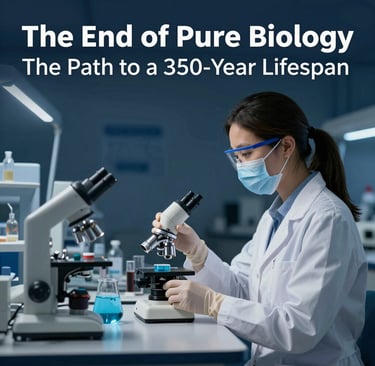
The End of Pure Biology: The Path to a 350-Year Lifespan
Past and future
Salamon & Salamon
4/27/20262 min read
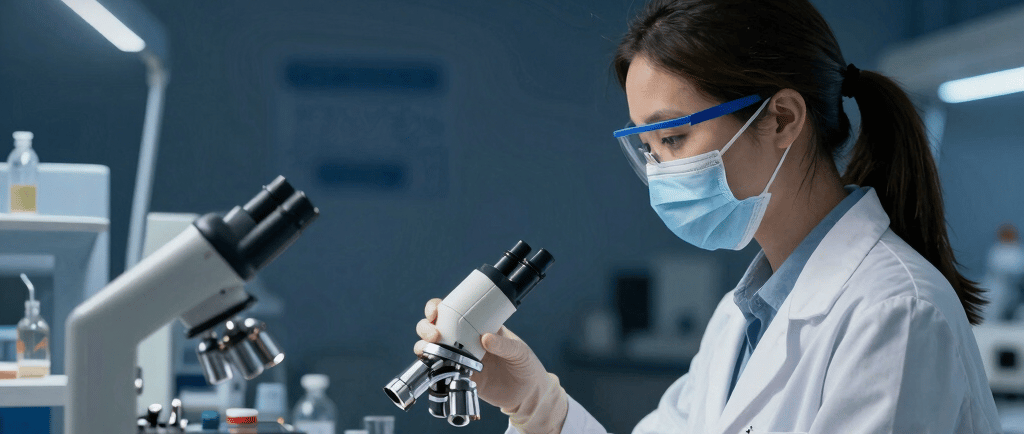
The boundary between what we call "natural" and "artificial" is becoming increasingly blurred. While traditional medicine focuses on treating diseases, a new breed of modern scientists—transhumanists and biohackers—argues that the key to extreme longevity lies not in pills, but in the definitive integration of carbon and silicon. The promise is bold: living to 350 years old.
The Machine-Man and Outsmarting Expiration Dates
The human body is essentially a biological machine with a programmed expiration date driven by cellular decay. The proposal gaining momentum in cutting-edge laboratories is progressive robotization. We aren't just talking about functional prosthetics; we are talking about:
Nanobots patrolling the bloodstream to repair tissues and eliminate pathogens before they manifest as disease.
Bio-hybrid organs that fuse living tissue with mechanical components that do not fail due to biological "fatigue."
Brain-Computer Interfaces (BCIs) that allow human consciousness to expand beyond gray matter.
By accepting that parts of our being will be robotic, we cease to be hostages to biological entropy. If a heart can be replaced by an electromechanical pump with century-long durability, the 120-year age limit becomes an obsolete barrier.
The Pharmaceutical Industry: The Containment Wall
If technology is already pointing in this direction, why aren't we living for centuries yet? For many longevity scientists and theorists, the greatest obstacle isn't technical—it’s economic.
The pharmaceutical industry generates trillions of dollars annually through the treatment of chronic diseases and the management of aging. In the current business model, a patient who lives to 80 while taking daily medication for blood pressure, cholesterol, and diabetes is extremely profitable.
A robotic or biotechnological solution that "cures" aging or replaces the need for constant pharmaceuticals represents an existential threat to the Big Pharma status quo. Maintaining our biological fragility is, today, one of the pillars of the global economy.
Alan Turing’s Vision: Beyond Artificial Intelligence
When we think of Alan Turing, we remember the father of computing and Artificial Intelligence. However, his vision went far beyond machines processing data in closed rooms. Turing was obsessed with the question: "What is life?"
Although electronics were primitive in his time, Turing already toyed with the idea that the mind was a computational system. He saw no mystical separation between human thought and a machine's processing power.
Turing predicted that, in the future, machines would be indistinguishable from human beings regarding intelligence. By proposing the famous "Imitation Game," he opened the door to a logical conclusion that modern scientists now embrace: if the mind is software, the hardware it runs on can be swapped.
Human-machine integration is the natural evolution of Turing's thought. If we can map the logic of thought (as he attempted to do), the transition of consciousness to more durable robotic supports stops being science fiction and becomes a matter of engineering and the political courage to face the financial interests that keep us tethered to bodies of flesh.
The Future is Hybrid
The human being of the future will not be "just" human. We will be a synthesis. The journey to 350 years requires us to let go of the idea that we are purely biology. The next evolutionary leap will not come from natural selection, but from our own ability to redesign ourselves. The only price? Ceasing to be purely human to become eternal.
Contact
Contact us for questions or suggestions
contact@turingvision.com
© 2026. All rights reserved.