Architecting the Turing Future: The Systematic Shift from Biological Toils to Autonomous Ethics
Shift
Salamon & Salamon
5/1/20263 min read
Abstract
This article examines the systematic obsolescence of traditional labor through a 20-year longitudinal lens. It explores how Artificial Intelligence (AI), the "Universal Machine" envisioned by Alan Turing, and Brain-Computer Interfaces (BCIs) will dismantle the current university model and reconstruct institutional ethics. By categorizing displacement into five-year increments, we map the transition from human-centered production to a post-scarcity, autonomous global infrastructure.
Introduction: The Fulfillment of the Turing Hypothesis
Alan Turing’s 1950 hypothesis—that machines would eventually compete with men in all purely intellectual fields—is no longer a theoretical exercise. As we approach 2030, the "Imitation Game" has been won. We are now witnessing the "Execution Phase," where the biological necessity in professional workflows is being surgically removed, favoring the tireless precision of algorithmic logic.Longitudinal Displacement Timeline: A Multi-Phase Analysis
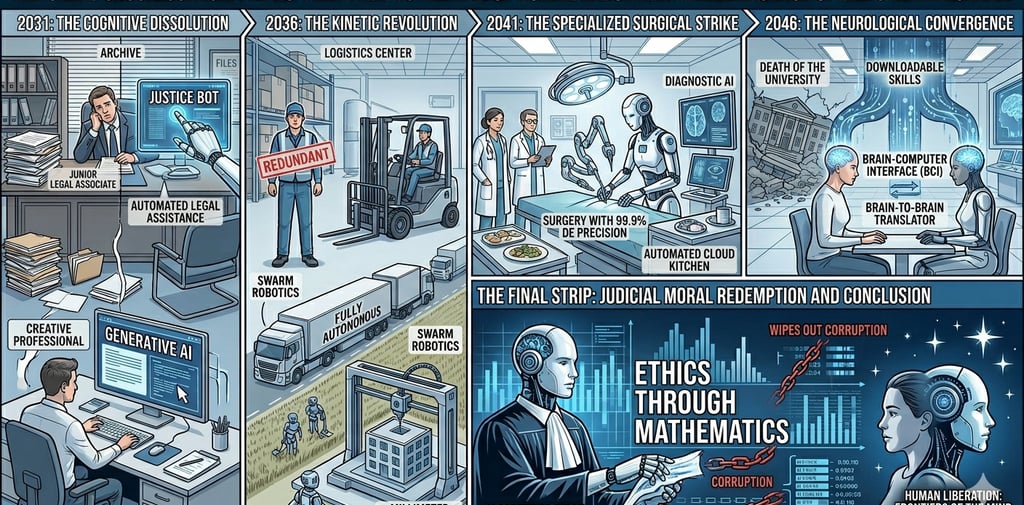
Phase I: The Cognitive Dissolution (5 Years – 2031)
Legal & Administrative: Junior Attorneys and Paralegals will see their primary functions—document review, petition drafting, and case law research—fully automated. In the Judiciary, administrative judges for small claims and traffic violations are replaced by "Justice Bots."
Creative & Media: Graphic Designers (entry-level), Copywriters, and Video Editors for social media. Generative AI creates high-fidelity content from simple prompts, making manual technical skills redundant.
Financial Services: Data Entry Clerks, Accountants, and Credit Analysts. Algorithms now assess risk and balance books in real-time with zero margin for error.
Phase II: The Kinetic Revolution (10 Years – 2036)
Logistics & Transport: Truck Drivers, Delivery Couriers, and Forklift Operators. Fully autonomous Level 5 fleets eliminate the need for human rest cycles.
Agriculture: Tractor Operators and Harvesters. "Swarm Robotics" manage planting and pest control with 24/7 efficiency.
Construction: Bricklayers and Painters. Robotic 3D printers and specialized limb-heavy robots handle structural assembly and finishing with millimeter precision.
Phase III: The Specialized Surgical Strike (15 Years – 2041)
Healthcare: Radiologists, Pathologists, and Pharmacists. Diagnostic accuracy reaches 99.9%, far exceeding human limits. Robotic dispensers replace the manual pharmacy role.
Culinary & Hospitality: Short-order Cooks, Baristas, and Hotel Staff. Fully automated "cloud kitchens" and robotic hospitality units provide consistent, high-speed service without labor disputes or hygiene risks.
Civil Engineering: Land Surveyors and Structural Inspectors. Autonomous drones and embedded sensors provide continuous monitoring, replacing the need for periodic human inspection.
Phase IV: The Neurological Convergence (20 Years – 2046)
Education: Traditional Classroom Teachers and Language Tutors. With Neuralink technology maturing, the "Downloadable Skill" replaces the 15-year educational cycle.
Translation & Diplomacy: Translators and Interpreters. Real-time, brain-to-brain translation removes the linguistic barrier entirely.
General Medicine: General Practitioners. The BCI monitors bio-markers in real-time, sending autonomous nanobots or instructions to home-automated medical kits, rendering the "office visit" a relic of the past.
The Death of the University and the Neuralink Paradigm
The traditional university model is predicated on the slow, biological transfer of information. Neuralink disrupts this by enabling high-bandwidth data transfer directly to the cortex.
The Shift: Education moves from "Acquisition of Information" to "Optimization of Synthesis."
New Domains: Careers will focus on Prompt Engineering for Biological Synthesis, Cyber-Neural Security, and Bio-Ethics Governance. The university of 2045 is a collaborative lab for philosophical breakthroughs, not a lecture hall for memorization.
The Judicial Moral Rescue: An Anti-Corruption Framework
In jurisdictions like Brazil, where the judiciary faces significant challenges with backlog and impartiality, the "Algorithmic Judge" offers a radical reset.
Ethics through Mathematics: By removing the human element, we remove the opportunity for bribery and ideological bias.
Productivity: A robotic judiciary can process the equivalent of 100 years of human legal work in a single afternoon.
The Turing Reaction: Turing, who faced personal injustice from a biased legal system, would likely view the autonomous judge as the ultimate achievement of human civilization—a system where the law is truly blind because it is written in immutable code.
Conclusion
The transition over the next 20 years is not merely an industrial revolution; it is an ontological one. As Marcelo Salamon and other legal professionals have observed, the move toward digital administration is the first step. The final step is the integration of man and machine. While professions will vanish, human potential—freed from the drudgery of survival labor—will be redirected toward the frontiers of the mind and the stars.
Summary
This longitudinal study maps the total transformation of global labor. By 2045, robotics will handle all physical logistics and surgery, while AI and Neuralink will automate the judiciary and the educational system. The result is a more productive, ethical, and intellectually advanced society that mirrors Alan Turing’s vision of a world where machine intelligence serves as the final tool for human liberation from corruption and inefficiency.
Contact
Contact us for questions or suggestions
contact@turingvision.com
© 2026. All rights reserved.