
Electrophysiological Symbiosis: Architecture, Augmented Cognition, and the Turing Legacy
Neuralink
NEURALINK
Salamon & Salamon
5/1/20263 min read
Introduction
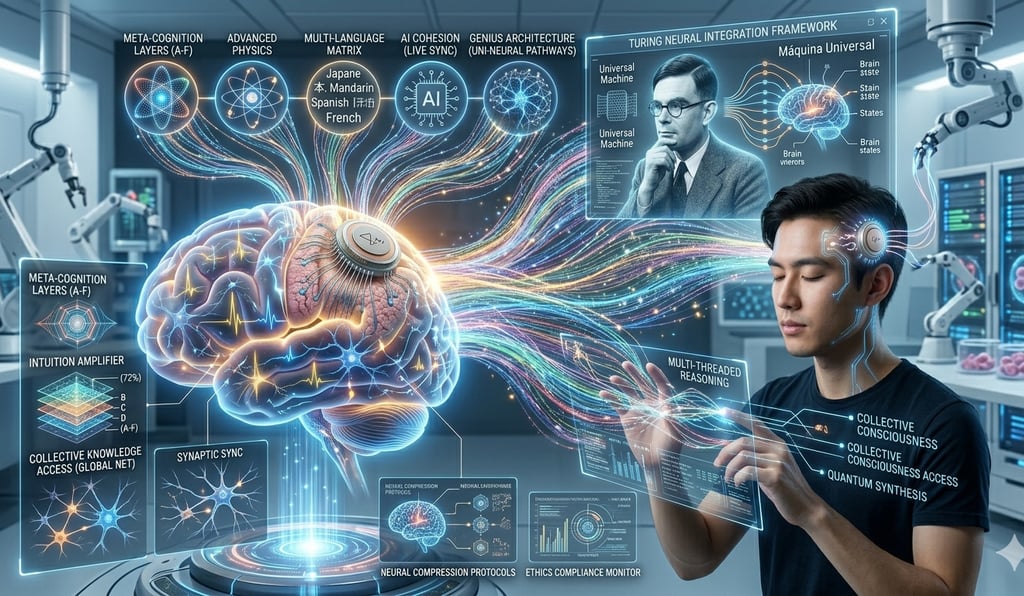
The Neuralink brain-computer interface (BCI) is not merely a medical tool, but the prelude to a revolution in human evolution. The system seeks a high-bandwidth integration between biological tissue and silicon, aiming not only for therapeutic cures but for cognitive upgrades. This article details the biophysical functioning, the possibility of instantaneous knowledge acquisition, and the implications for human intellect.
The Biophysical Interface: Electrodes and Neurons
The core functionality is based on the translation of action potentials. The brain operates via ion flows (sodium, potassium, and calcium) that generate electricity.
Extracellular Recording: Ultra-fine threads capture electrical fields in the interstitial space without piercing the neuronal membrane.
Impedance Matching: Biocompatible materials prevent gliosis (scarring), ensuring that communication between the chip and the neuron remains fluid over the long term.
Signal Processing: The N1 chip performs amplification and filtration of microvolts, converting them into digital data via Analog-to-Digital Converters (ADCs). Using spike sorting algorithms and machine learning models, the system decodes neuronal patterns, associating firings with commands or concepts.
The Cognitive Leap: Knowledge via "Download"
The great frontier for Neuralink is the transition from motor decoding to semantic and symbolic decoding.
Languages and Technical Knowledge
Today, learning a language requires years of synaptic plasticity. With Neuralink, this process could be subverted:
In-Situ Translation: The chip could act as a real-time translator, where the auditory signal of a foreign language is processed and "injected" into Wernicke’s and Broca’s areas as if it were the native tongue.
Academic Downloads: Complex technical knowledge involves the creation of specific neural networks. The chip would not just "deliver" data but stimulate the formation of synaptic patterns. In theory, access to external libraries would make the accumulation of encyclopedic information instantaneous.
Brain Augmentation and the Question of Genius
Contrary to the myth that we use only 10% of our brains, Neuralink allows for parallel and optimized utilization of the organ's full capacity.
Genius: Hardware vs. Software
If everyone has access to the same database, what defines a genius?
Relative Biological Capacity: Even with the chip, the underlying brain architecture (synaptic density in the prefrontal cortex, biological processing speed) varies. The chip enhances what already exists.
The New Genius: Genius will no longer be defined by who "stores" the most information, but by who possesses the greatest capacity for synthesis and intuition. Intelligence will shift from "data storage" to the "architecture of unprecedented connections."
Risks of Manipulation and Cybersecurity
The bidirectionality of the chip (read and write) introduces significant vulnerabilities:
Cognitive Hacking: The possibility of injecting false signals to induce specific beliefs or movements.
Privacy and Sovereignty: The risk that "downloaded knowledge" comes bundled with behavioral control algorithms or dopamine modulation to create interface dependency.
Alan Turing’s Perspective: The Universal Machine and the Brain
If Alan Turing, the father of computing, analyzed Neuralink, he would see the realization of his "Universal Machine."
The Biological Turing Test: Turing believed there was no fundamental difference between machine and brain processing if the results were indistinguishable. He would view Neuralink as the hardware that finally allows the human brain to run external "software."
Computing the Mind: For Turing, the brain was a "finite state machine" on a biological scale. He would likely focus on how discrete logic (bits) can merge seamlessly with continuous logic (biology) without losing the essence of consciousness.
Practical Implementation: Trials and Registration
The transition from theory to practice has already begun with the PRIME Study (Precise Robotically Implanted Brain-Computer Interface).
Current Status (May 2026)
As of May 2026, Neuralink has expanded its trials to dozens of participants globally. Early patients, such as Noland Arbaugh, have demonstrated the ability to control computer cursors and play complex video games using only thought. Current focus areas include:
Quadriplegia due to cervical spinal cord injury or ALS.
Vision restoration (the Blindsight project).
How to Apply
Neuralink maintains an official Patient Registry for those wishing to participate in future studies.
Application Link: [neuralink.com/patient-registry](https://neuralink.com/patient-registry)
Requirements: Currently, priority is strictly medical for individuals with severe disabilities. As of 2026, there is no enrollment for healthy volunteers seeking "cognitive enhancement."
Critical Risks: The Dark Side of Silicon in the Cortex
Thread Retraction: Early trials showed that threads can pull away from brain tissue due to the brain's natural movement within the skull.
Inflammation and Rejection: Chronic inflammation can permanently damage neurons, leading to cognitive loss.
Hardware Failure: A malfunctioning chip could generate excessive heat, effectively "cooking" neurons via micro-burns.
Technological Dependency: If the brain becomes accustomed to processing via the chip, a system failure could leave an individual in a state of "cognitive blackout."
Conclusion
Neuralink is not just a promise; it is a biophysical construction site. While Alan Turing predicted machine intelligence, we are now living in the era where that intelligence seeks residence within us. This quantum leap for humanity is conditioned on one question: Are we ready for the risk of a system crash inside our own minds?
Contact
Contact us for questions or suggestions
contact@turingvision.com
© 2026. All rights reserved.