Alan Turing: The Academic Rebel Who Built the Future
Descrição do post.
BIOGRAPHY
Salamon & Salamon
4/28/20264 min read
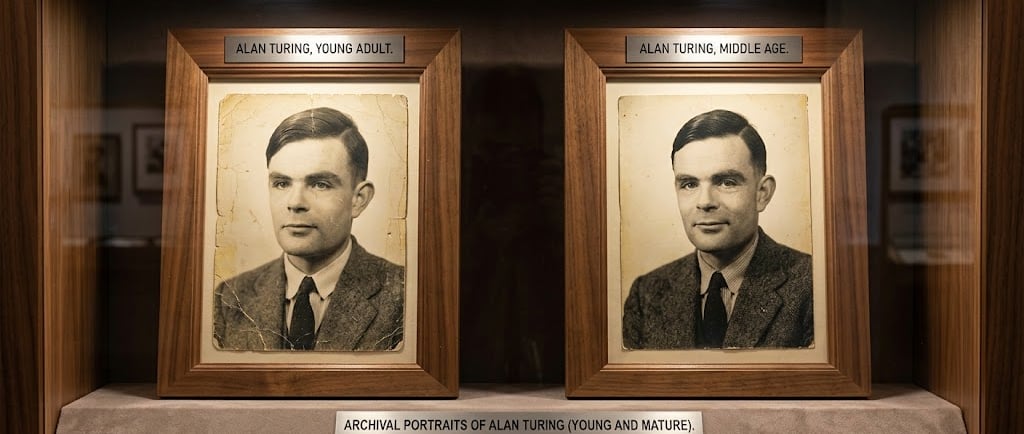
Alan Turing is frequently remembered as the "father of computer science," but his academic trajectory reveals a genius who often collided with the rigidity of the educational system of his time. He was not the "perfect student" in the traditional sense; he was, in fact, a highly undisciplined thinker who preferred to rediscover scientific principles on his own rather than follow pre-established curricula.
Here is a deep dive into Turing’s educational journey, from his schoolroom resistance to his revolutionary discoveries.
Primary Education and Sherborne School (1926–1931)
The curriculum at Sherborne School, where Turing studied as a teenager, was heavily focused on the Classics (Latin, Greek, and Literature). Turing, however, had an almost exclusive fixation on natural sciences and mathematics.
Behavior: His teachers were frequently frustrated. He was described as "sloppy" in his humanities lessons. The school’s headmaster even wrote to Turing’s parents: "If he is to be solely a Scientific Specialist, he is wasting his time at a Public School."
Preferences: Turing ignored textbooks. At age 16, he encountered the work of Albert Einstein and not only understood it but extrapolated Einstein's doubts about Newton's Laws in a private notebook.
The Catalyst: The death of his close friend, Christopher Morcom, in 1930, was the emotional event that pushed him definitively toward science. Turing became obsessed with understanding how the human mind (the "soul") could survive after death, which led him to study quantum physics and brain biology.
Undergraduate Studies at King’s College, Cambridge (1931–1934)
Upon entering Cambridge University to study Mathematics, Turing finally found an environment that valued his intellectual eccentricity.
The Curriculum: Focused on mathematical analysis, number theory, and logic.
Behavior: Turing was a brilliant student but still unorthodox. He preferred to work in isolation. In 1934, he graduated with First Class Honors.
Academic Achievement: At just 22 years old, he was elected a "Fellow" of King’s College after submitting a dissertation where he proved the Central Limit Theorem, unaware that it had already been proven years prior. The fact that he reached the same result independently impressed the faculty through the sheer originality of his method.
Graduate Work and the Leap into Computer Science
The turning point occurred between 1935 and 1936, under the influence of logician Max Newman.
Hilbert’s Problem: Turing was exposed to the Entscheidungsproblem (the decision problem), which questioned if a definite method (an algorithm) existed to decide if any mathematical statement was true or false.
The "Turing Machine": To solve this, he published the paper "On Computable Numbers, with an Application to the Entscheidungsproblem." He didn't just solve a logical problem; he conceived the idea of a Universal Machine, a theoretical framework that defines how every modern computer functions today.
PhD at Princeton University (1936–1938)
Turing moved to the United States to work with Alonzo Church, one of the world’s leading logicians.
Focus of Study: Mathematical logic and cryptography systems.
Additional Interests: It was at Princeton that Turing began to take an interest in the physical construction of machines. He spent part of his time building an electromechanical binary multiplier and studying the use of relays to encode messages.
Completion: He obtained his PhD in 1938. His thesis introduced the concept of Systems of Logic Based on Ordinals and the idea of "Oracles," which allowed machines to solve problems that were not purely algorithmic.
What Drove Him to Science?
For Turing, science was not just a profession; it was a search for fundamental answers about nature and the mind.
Investigative Curiosity: He detested accepting facts as given; he needed to derive them himself.
Practical Necessity: During World War II, his theoretical education was applied at Bletchley Park to break Nazi encryption (Enigma), proving that mathematics was the most powerful weapon of the 20th century.
Mechanization of Thought: His fascination with biology led him, late in life, to study Morphogenesis (how natural patterns like zebra stripes form), attempting to find the mathematics behind life itself.
Turing was the ultimate example of a student the system tried to prune, but who flourished precisely by ignoring the fences of the traditional curriculum.
CGraduate Work and the Leap into Computer Science
The turning point occurred between 1935 and 1936, under the influence of logician Max Newman.
Hilbert’s Problem: Turing was exposed to the Entscheidungsproblem (the decision problem), which questioned if a definite method (an algorithm) existed to decide if any mathematical statement was true or false.
The "Turing Machine": To solve this, he published the paper "On Computable Numbers, with an Application to the Entscheidungsproblem." He didn't just solve a logical problem; he conceived the idea of a Universal Machine, a theoretical framework that defines how every modern computer functions today.
PhD at Princeton University (1936–1938)
Turing moved to the United States to work with Alonzo Church, one of the world’s leading logicians.
Focus of Study: Mathematical logic and cryptography systems.
Additional Interests: It was at Princeton that Turing began to take an interest in the physical construction of machines. He spent part of his time building an electromechanical binary multiplier and studying the use of relays to encode messages.
Completion: He obtained his PhD in 1938. His thesis introduced the concept of Systems of Logic Based on Ordinals and the idea of "Oracles," which allowed machines to solve problems that were not purely algorithmic.
What Drove Him to Science?
For Turing, science was not just a profession; it was a search for fundamental answers about nature and the mind.
Investigative Curiosity: He detested accepting facts as given; he needed to derive them himself.
Practical Necessity: During World War II, his theoretical education was applied at Bletchley Park to break Nazi encryption (Enigma), proving that mathematics was the most powerful weapon of the 20th century.
Mechanization of Thought: His fascination with biology led him, late in life, to study Morphogenesis (how natural patterns like zebra stripes form), attempting to find the mathematics behind life itself.
Turing was the ultimate example of a student the system tried to prune, but who flourished precisely by ignoring the fences of the traditional curriculum.
Conclusion: A Legacy Beyond the Classroom
Ultimately, Alan Turing’s education was defined not by the grades he earned, but by the questions he refused to stop asking. His journey proves that true innovation often requires a healthy disregard for "the way things have always been done." By bridging the gap between abstract mathematical logic and the physical world, he transformed the computer from a theoretical concept into a reality that reshaped human history.
Turing’s story remains a powerful reminder that the most unconventional minds—the ones who struggle to fit into rigid boxes—are often the ones capable of rebuilding the world from scratch. He didn't just pass his exams; he decoded the future.
Contact
Contact us for questions or suggestions
contact@turingvision.com
© 2026. All rights reserved.