AI in 2026: Complete Guide to the Main Artificial Intelligences – Features, Strengths, and Honest Comparison
Artificial Intelligences
AI
Salamon & Salamon
5/12/20263 min read
Introduction
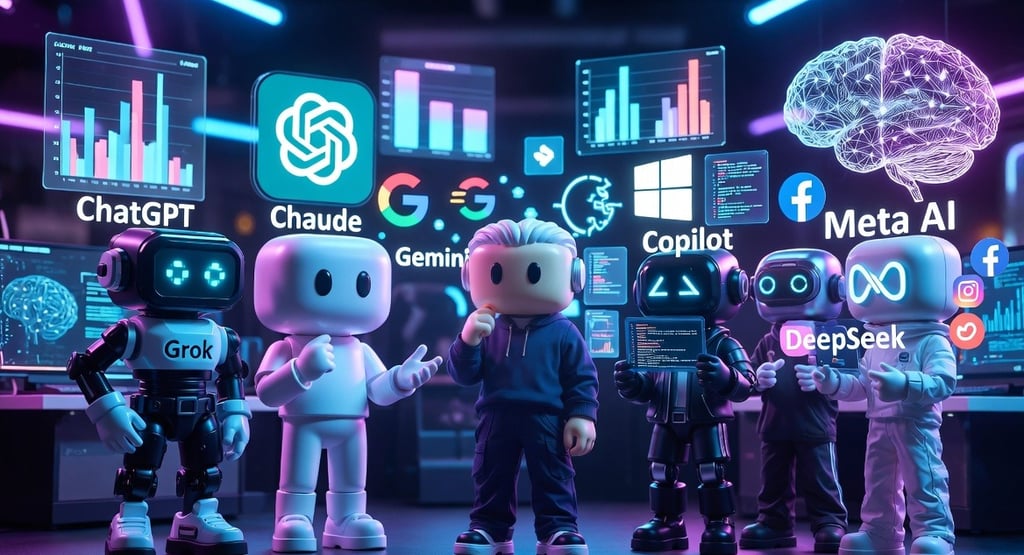
Generative Artificial Intelligences have become essential tools in both professional and personal life in 2026. The landscape is highly competitive, with different models excelling in creativity, deep reasoning, speed, integration, or transparency.
In this expanded article, I present the top AIs in a clear, honest, and comparative way, including three relevant additions: Microsoft Copilot, DeepSeek, and Meta AI. The goal is to help you choose (or combine) the best tools according to your specific needs.
Main AIs and Their Characteristics
ChatGPT (OpenAI)
Main Models: GPT-4o, o3 (advanced reasoning), GPT-5 series.
Key Functions: General conversation, creative writing, programming, data analysis, image generation (DALL·E), voice, and video.
Advantages: Mature ecosystem, high versatility, long memory, and excellent multimodality.
Disadvantages: Can be overly cautious on sensitive topics; advanced versions are more expensive and slower.
Best for: Everyday use, content creators, and businesses.
Claude (Anthropic)
Main Models: Claude 4 Opus / Sonnet.
Key Functions: Complex reasoning, long document analysis, advanced programming, and structured writing.
Advantages: Outstanding at deep, step-by-step tasks, massive context window (1M+ tokens), strong in coding and ethical responses.
Disadvantages: Refuses more controversial tasks; sometimes less creative in artistic scenarios.
Best for: Developers, researchers, lawyers, and technical/ethical work.
Grok (xAI)
Main Models: Grok 4 / Grok 4.20.
Key Functions: Honest answers, humor, scientific reasoning, real-time search on X (Twitter).
Advantages: Maximum transparency, minimal censorship, excellent at current trends, memes, and unconventional thinking. Strong in coding and math.
Disadvantages: Ecosystem still growing compared to the market leaders.
Best for: Unfiltered truth, real-time trends, and bold research.
Gemini (Google)
Main Models: Gemini 2.5 / 3.1 Pro and Flash.
Key Functions: Real-time search, advanced multimodal analysis (video, audio, images), and Google ecosystem integration.
Advantages: Extremely fast (especially Flash), native integration with Gmail, Docs, YouTube, and great cost-performance ratio.
Disadvantages: Can be inconsistent or overly cautious in responses.
Best for: Google Workspace users and fast multimedia tasks.
Microsoft Copilot
Main Models: Powered by GPT with deep Microsoft integrations.
Key Functions: Productivity inside Microsoft 365 (Word, Excel, PowerPoint, Teams, Outlook).
Advantages:
Deep integration with corporate tools.
Real-time analysis of emails, spreadsheets, and meetings.
Strong balance between enterprise security and capability.
Disadvantages: Requires Microsoft 365 subscription; less flexible for general creative use.
Best for: Companies and professionals living in the Microsoft ecosystem.
DeepSeek
Main Models: DeepSeek R1 / V3.
Key Functions: Logical reasoning, advanced mathematics, and programming.
Advantages:
Excellent cost-benefit (often open-source or very affordable).
Top-tier performance in coding, logic, and technical tasks.
High computational efficiency.
Disadvantages: Weaker in creative conversation and multimodality.
Best for: Developers, STEM students, and those needing strong technical performance on a budget.
Meta AI
Main Models: Llama-based (Meta AI).
Key Functions: General conversation, image generation, integration with WhatsApp, Instagram, and Facebook.
Advantages:
Widely available for free through social platforms.
Solid image generation and multimedia.
Easy and convenient for casual use.
Disadvantages: Less advanced in deep reasoning compared to frontier models.
Best for: Everyday use, social media, and quick image creation.
Llama (Meta) and Open-Source Models
Advantages: Full privacy (can run locally), extreme customization, and low cost.
Best for: Privacy-focused companies and developers.
Perplexity AI
Advantages: Research with cited sources and low hallucination rate.
Best for: Journalism, academic work, and fact-checking.
Summary
ChatGPT → The versatile all-rounder.
Claude → The deep and reliable thinker.
Grok → The most transparent and up-to-date.
Gemini → The fast and Google-integrated option.
Copilot → The king of Microsoft enterprise productivity.
DeepSeek → The technical and math specialist with great value.
Meta AI → The accessible everyday and social choice.
Perplexity → Reliable research.
Open-source (Llama etc.) → Maximum privacy and control.
Conclusion
In 2026, the winning strategy is not choosing just one AI, but building your own stack. Many professionals use Grok for honest ideas, Claude for deep work, Gemini or Copilot for productivity, and Perplexity or DeepSeek for research and coding.
AI amplifies your abilities — but human judgment remains irreplaceable. Test different models, understand their strengths, and use them wisely.
Which of the three new additions (Copilot, DeepSeek, or Meta AI) are you planning to try first? Or what’s your current favorite combination? Let me know in the comments!
Contact
Contact us for questions or suggestions
contact@turingvision.com
fone: + 55 54 99122 0659
© 2026. All rights reserved. https://www.turingsvision.com/privacy-policy